There are always better ways to do things. There will always be new technologies that come along that make doing our jobs easier and more effective, but are they the right fit for the Department and its people? If you see a need and can do something to satisfy it, then by all means do so! If we all waited around for things to improve, we would never grow as an organization or as people. However, we must do so logically, efficiently, and cost-effectively to ensure success.
Innovation through Process Improvement
One of the simplest ways we can innovate is through Process Improvement. Look around you and look closely at the tasks you or your customers are doing, and then see if you can come up with a way to do things more efficiently and/or effectively. Talk to your customers and develop a requirements list to determine what your customer needs and how you can effect positive change through process efficiencies. Don’t try to improve processes in a vacuum. Your customers will be the ones using your changes and it isn’t much of an improvement if it is confusing, creates more work, or simply does the same thing in a different way. If it doesn’t save time, reduce steps, save money, increase security, or in some way make it better for them, then you likely aren’t improving anything.
Innovation through Projects, Products, and Services
Another way to innovate is to introduce a new project, product, application, or service (we’ll just call it a project from here on out) that can improve the way we do business. It can be something completely new that has never been done before or it can be a project that replaces an existing one but does a better job of it. One thing to remember is that new isn’t always better. So, if you are going to bring something new to the table, it should do most of everything the old one did plus something better than what is already out there. No one wants to go from a Buick back to a Chevy…they want to move up to a Cadillac.
Be creative, but most importantly, talk to your customers. You may have a great idea, but your customers may see it as only adding more work to their already heavy schedules. Find ways to make their jobs easier and you can bet they will be onboard with you, 100 percent.
Innovation Always Requires Resources
You may think that your idea is a cost-free proposition, but you need to immediately think again. Nothing is free when it comes to doing business and I mean nothing. There may not be a direct bill for your proposal but believe me there are indirect costs that must be taken into consideration or your project will never pass muster with the higher ups. One thing I learned that burned into my brain while I was Special Assistant in the IRM Executive Development Program is that IT folks are not very good at pitching proposals to senior management. The primary reason is because they only address two things when they are standing before the senior staff: 1) the technology they want to propose and 2) a ballpark cost. That is pretty much it and I would then sit there, dutifully taking my notes for the meeting and watch, in abject horror, as they were summarily dressed down by the CIO, DCIO, or Director they were pitching their project to.
This was a real eye-opener for me to witness but watching them being picked apart taught me more than anything I could have learned in a classroom. Because of it, I was able to successfully submit proposals for two enterprise-wide projects – one that cost less than $30K and one that cost close to $4.5M. What my project proposals had, that separated mine from those that failed before, was that I addressed each and every factor that executive decision makers need to have in front of them to make an informed decision. I learned that there are six factors that every project being proposed must address. They are: 1) Cost, 2) People, 3) Process, 4) Technology, 5) Change, and 6) Security.
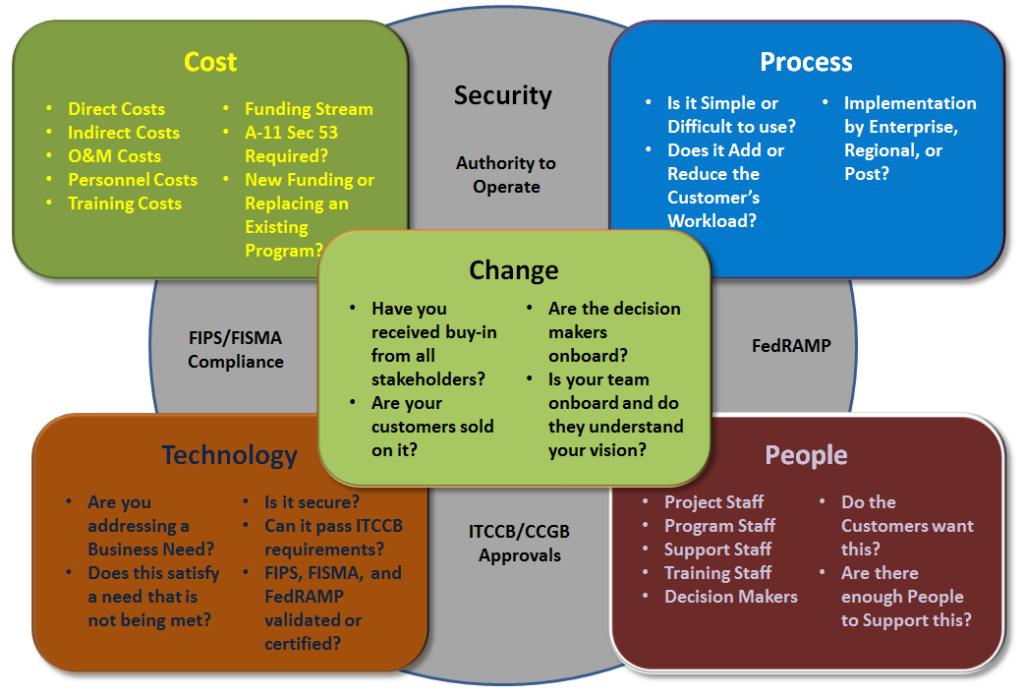
Addressing the Cost Factor
Everything costs money when it comes to work. It will be in one of two forms: 1) Direct costs and 2) Indirect costs. We will then need to decide how to fund the project if it is approved.
- What are the direct costs involved?
- What must be procured?
- What
are the recurring costs?
- Annual maintenance contracts, upgrades, etc.?
- Licensing costs (per server, per seat, per device, etc.)?
- What are the indirect costs involved?
- How
many employees is this going to take to succeed?
- More about that in the People Factor.
- What
is it going to cost to train everyone in the use and administration of your
project?
- Can
it be done via distance learning (DL) or must it be done in a classroom?
- If via DL, what will it cost to develop and deploy the online training course?
- If in the classroom, which office or bureau will provide the training; where will it be provided; and who will pay the travel/lodging/per-diem costs?
- Can
it be done via distance learning (DL) or must it be done in a classroom?
- Once we have the above questions answered, you will need to calculate the number of workhours this is going to take and tally up the payroll cost for the hours these people are working on your project. (Another Hint: No matter what you may think, if you have people, including yourself working on this, even if only for an hour a day, they are still being paid to do their jobs and like it or not, your project is taking away from this and someone (for my job it is the American taxpayer) is paying for it, so you must factor this in.)
- How
many employees is this going to take to succeed?
- Where is the money for this project going to
come from?
- Is
this new money that we are going to have to find?
- Is it realistically feasible in this budget climate?
- Are we ending a project or program and using the money to replace it with this project?
- Is
this new money that we are going to have to find?
Addressing the Process Factor
Whether it is an application, a new way of doing things, or a new device; it will take a specific process or processes to successfully use and/or administer your project. There are four important questions you must ask to see if your project can be successfully approved:
- If this is a new technology; how much work is this going to add to your customer’s workday?
- Have you gathered the requirements from the customer? In other words, are you handing them a piece of technology or an application cold or have you actually talked to your customers and then looked at their needs to harness this technology/application to improve processes?
- If this is not a new technology or if you are replacing an existing program with your project; is the technology that you are proposing going to require more work or less work by the customer to use it?
- How will this be implemented? Will it be an enterprise rollout, by region or will each work center be expected to implement it individually?
Addressing the People Factor
Unless your project runs autonomously in a vacuum, you will need to address the people factor.
- How many people will it take to bring this project to life?
- How many people will it take to make this project an operational program?
- How many people will it take to provide
technical and user support?
- For how long will this support be ongoing?
- Do people even want this project?
Addressing the Technology Factor
Now we’re at the crux of your project: The technology itself. It does not matter if it is hardware or software, you should, at a minimum, ask these questions:
- What business need are you addressing?
- Does it need to be addressed?
- Do
your customers want it to be addressed?
- Are you adding to an already heavy workload or are you helping them to do their jobs more efficiently?
- If this is a new technology; what does this technology do that nothing else in use now does?
- If this is not a new technology; what technology that is currently in use is your technology replacing?
- For a government project: Can the project pass muster with the IT
Change Configuration Board (ITCCB) or Cloud Configuration Governance Board
(CCGB)?
- Is it NIST-FIPS, FISMA, and FedRAMP validated/certified?
Addressing the Change Factor
The next factor is addressing change. Change Management is rarely taken into consideration when it comes to technical folks proposing and/or implementing a project, but it is the one factor that will absolutely guarantee failure if not fully, and properly, addressed. Many organizations have a very change-averse culture, so you have some high hurdles to overcome if you want to see people using your project at all.
Getting Buy-In by the Stakeholders
The first thing you will need to do is to get all stakeholders involved. This includes everyone from the decision-makers who will green-light your project down through the staff who will develop and implement the project, and on through to the customers who will use it and the staff who will support it. If you do not have full agreement and buy-in from everyone then your project has already failed.
- Does the decision-maker believe in your project
enough to give it the green-light?
- Did you address everything they need to make an informed decision?
- Does the team understand and believe in what you
are doing?
- Do they want to be a part of this project?
- Do your customers understand what your project
does?
- Do
they want it or are they pushing back?
- How do you convince them that what you have is better than what they are already doing now?
- Do
they want it or are they pushing back?
- Do the staffs who will be assigned to support
the project understand the project enough to be able to help customers with
their issues?
- Do they believe in your project enough to give you their best to support your customers?
Keeping Stakeholders Involved in Your Project’s Development and Implementation
Second, make sure that all stakeholders are involved in your project. It can be as simple as weekly reports posted on a SharePoint site to involving everyone in beta tests and pilot testing. The more involved they are from the beginning, the better the chance that they too will want this project to succeed.
Training, Customer Support, and Lifecycle Support
Finally, once you are ready to deploy your project, you must ensure that those using it are properly trained in its use and then ensure that they receive the support they need to keep using it or they will give up on it very quickly. If you think you can just walk away once it is deployed, you really need to wake up and smell the coffee. You will need to be involved for the entire lifecycle of your project or train and prepare to pass the torch to the person who will. Many a project has fizzled out because the person spearheading it either did not pick someone to carry on their work or picked the wrong person who then let it die on the vine.
Addressing the Security Factor
If you are not looking at security as an integral resource factor of your project, then you have already failed. This must be addressed at the very beginning or, as my Information Security professor at the National Defense University’s iCollege always drilled into us: “Security must be baked into your project at the beginning, not frosted on at the end.” Any government IT application project must have, at a minimum: 1) ITCCB and/or CCGB approvals, 2) FedRAMP certification for the application and the hosting server/facility, 3) NIST FIPS and FISMA compliance certifications, and 4) Authority to Operate (ATO) from the CIO. Without these, your project will never be able to go forward. All other resource factors will have a security component to them, so it is imperative that you ensure security is addressed for each factor, at each stage, and at every level of your project.
- Security and Cost – Securing systems and applications is not a cheap effort. The ATO process alone can cost upwards of $500,000.00 depending on the nature of the application or system. FedRAMP can cost upwards of $1,000,000.00 or even higher. All of this is done to ensure our data and the infrastructure it resides on guarantee the confidentiality, integrity, and availability required to make the project viable.
- Security
and People – Are the personnel working on this project, and then those who
will use it, cleared to access the project/application and are they properly
trained to ensure that they are using it securely? Are they vigilant in ensuring good cyber
security practices? Without addressing at
least, the above concerns, your project could become compromised and the
information it contains becomes open to malicious exploitation or
manipulation.
Security and Processes – Every step of the way, your project or application must place a focus on how it does what it does in a secure way. It can be as simple as two factor authentication to login/access an application, to file/folder rights assigned to those accessing the information. - Security and Technology – All technologies used by the Federal Government must meet NIST FIPS, FISMA, and FedRAMP standards. This must be factored in at the very beginning of a project because it will take the longest time to complete.
- Security and Change – As part of the change management process, all stakeholders must understand how and why a project/application is being secured and that they all understand the importance of securing the project. If the security factor is addressed after stakeholder buy-in, it is likely to get push-back, and the project stands a good chance of being rejected because of it.
A Humorous, yet “Rock Solid” Example
Tying all of what I have covered here, I wanted to give you a good example of a project proposal that both failed miserably when it was first proposed but was then green-lighted once all factors were addressed. I could have used an IT related project for this, but I decided to talk about one outside of our field of view simply because the project itself was simple in its form, had no security issues to address, but it was difficult in its execution. That and looking back, it was a funny story to tell.
A few years back, I was the on the board for the American school in Israel. A project was proposed by one of the teachers for a rock garden near the entrance to the school cafeteria. The presentation went on for just over an hour (presenters were allotted three minutes) and in that time, we listened endlessly, about how a school in Spain and another in The Netherlands did similar rock gardens and that it brought beauty and joy to all who saw it. Man did this teacher like to talk about rock gardens. I learned more about how rock gardens bring absolute joy to all who are lucky enough to be in eyeshot than any individual human being ever ought to know about them…well…ever.
When the teacher finally stopped this hour-plus opus, I asked how much this was going to cost. The answer I got was $250 for the rocks/stones and associated plants. That was where it stopped. I asked who was going to perform the work and the answer was that the volunteers (students, parents, teachers, and anyone else who wanted to pitch in) would do it over a weekend during summer break and that would mean free labor for the project. I asked if there was anything else that would be factored in and the answer was no.
We immediately and unanimously rejected the proposal.
This was not a teacher who took no for an answer and right there and then demanded that we explain why it was denied. My answer was simple: You aren’t even in the ballpark for how much this is going to cost. Come back with realistic costs and we will decide on the proposal again at the next board meeting. The teacher was even more flustered and again demanded that it be decided on now, and that $250 was all this was going to cost and not a penny more. That is when I took what I had learned as an SA and did some schooling of this teacher of my own.
I said “ok, you insist that $250 is going to cover it all. What exactly is this $250 going to cover?” The teacher’s answer, again, was for the rocks/stones and associated plants for the garden, and everything else would be free through volunteers. Not a penny more would be needed and that was that. “Ok” I said, “you said this would be done during the school summer break, when it is, on average, 95 degrees Fahrenheit during the day. Will there be no water provided for the volunteers throughout the day? Will that water not need coolers and ice? Do you expect the volunteers to go hungry for the entire 8 hours of each day you plan to have them working? Sure, they could bring lunches, but is that fair? What about snacks for breaks? Do you have some kind of sponsor to provide food and drinks?”
“Are the rocks going ‘au natural’ or will they be painted as was shown in your presentation? How much will paint and all the associated tools and supplies you’ll need to paint the rocks cost? Will they be painted in place or painted in a separate area then moved when dry? Who will be directing the placement of the rocks to make sure they are properly placed? How will the responsibilities be divided to ensure the project is managed smoothly? How much time will all of this take?” All I received was a blank stare and stone-cold silence (excuse the pun).
I went on… “Since it is going to be hot; will there be a medical professional available? A school nurse, someone from a nearby hospital, or perhaps a private ambulance service? You are going to have a lot of people working in direct sunlight during the heat of the day. What happens if someone falls ill from heat exhaustion or heat stroke? Do you think that any of these medical professionals are going to ‘volunteer’ for this? Since it is on school grounds, I can tell you that Israeli law will require us to have someone present and it will not be on a ‘volunteer’ basis.” More silence.
“Finally, once the project itself is done, who exactly will maintain this spectacle of wonderment over the next year, two years, five years, etc.? Are these so called ‘volunteers’ going to come back periodically and tidy things up or do you expect the facilities maintenance staff to do it?” Facilities Maintenance would do it was the reply to that question, so I went on… “Ok, how many work hours will that take to accomplish? It is, after all, a lot of rocks to paint, not to mention that kids, being kids, will probably grab handfuls of them from the garden over time and spread them out all over the school grounds. Murphy’s Law will make sure that weeds will pop up everywhere in that rock garden and someone is going to have to tend to that to keep it, as you said, a joy to behold. That means the facilities staff must take time away from their current assigned tasks to take care of this rock garden and replenish it, yet accomplish their currently assigned tasks, nonetheless. Was the payroll for their hours worked considered?” Still more silence, but at least the once hard stare shifted its focus to the floor.
I made it clear that if the teacher came back with a proposal that addressed every aspect of the project and not just the altruistic story and ballpark cost, that we would seriously consider the proposal. A month went by and another board meeting later and our teacher with a passion for rock gardens came before the board once again. This time, with the real costs involved to implement the project. Factoring in everything, the initial project cost was going to be more in the line of $3500 over a four-day period and between $700 and $1000 per year (depending on how many stones needed to be replaced and repainted) for lifecycle maintenance. That sounded more like what it should cost.
Thinking that this was an exercise in futility, the teacher – much more focused on the business view of the project this time – figured that the cost would be too much for the board to approve. However, we did listen to everything (not the presentation again…we put a stop to that right away) that was originally proposed and now that we had the actual costs for the project and its lifecycle management, we were more than happy to green-light the project. After the summer break was over, I was delighted to see the new rock garden as I came in for my first board meeting for the new school year; especially with the knowledge that it was done safely, effectively, and would be tended to for the long-haul.
The point of this story is that although you may have a great idea for a project, you must address a much wider view that ensures that an informed decision can be made that encompasses the real Cost factor of a project – tangible and intangible, direct and indirect – along with the People, Process, Technology, Change, and Security factors to paint a clear picture that makes the odds for approving your proposal much better than if you just walk in with an idea and a vague guess on a price.
Getting Decisions Made Based on Your Recommendations
As important as ensuring that the content of your proposal is in place, so is ensuring that your argument is solid enough that you will convince the decision-maker that your proposal and its path forward are the way to go. To help you with formulating your argument, see my post on Developing a Solid Written Argument.