We Need to Have A Frank Discussion on the Adoption of New Technologies
Before any organization dives headfirst into buying the latest and greatest technologies – be it hardware, software, infrastructure, cloud, etc. – it is important that we have an honest talk about the adoption of new technologies from a business perspective. Many organizations adopt the latest and greatest thing because of the buzz. This is especially true for mobile devices, where they shell out a thousand dollars for a phone that does exactly the same thing as a three-hundred-dollar phone that isn’t as shiny or has a popular logo/name stamped on it. In my job, I work for the American taxpayer and it is my duty to ensure that the monies we are given to perform our mission are spent wisely.
Not all existing technology can solve today’s problems. New technologies, both hardware and software, are being developed and deployed that can address operational needs that were not available just a few years ago. Robotic Process Automation (RPA) and Artificial Intelligence (AI) are prime examples. We must first determine if a technology is right for our needs. Does it solve a problem, meet a business need, increase efficiency, improve processes, or is it just the latest buzz around the water cooler with enough glitz and glamor that everyone wants it because it’s cool?
To do that, we need to ask ourselves two very important questions:
- Is this a completely new technology that has never existed before or is this going to replace an existing technology that is being used to meet current organizational needs? and
- What business need are you meeting with this technology and what benefit does it bring to the organization?
There are new and emerging technologies that were only in the realm of science fiction up until very recently, such as Artificial Intelligence (AI). AI is transforming how we do business and it is only in its infancy. If I am going to propose that my organization spend $50K on a new system, I must show that benefit to the organization is going to be there. Be it through direct cost savings or indirect cost savings, such as process improvements, or increased efficiencies. I cannot possibly propose that monies be spent for the sake of the technology alone.
Regardless of the technology, there are five criteria that I believe must be addressed before making the decision to adopt a new technology:
Criteria 1 – Cost: What is this new technology going to cost the American taxpayer? If it is replacing an old technology, is it cheaper than what it is replacing or more expensive? If more expensive, can you show that there will be a Return on Investment (RoI) – within a reasonable timeframe – that will make the cost worthwhile? It doesn’t have to be a zero-sum deal, but you must demonstrate that the cost adds some kind of value to the organization.
Direct cost savings are easy to demonstrate. If you spent $75,000 on an Internet Service Provider (ISP) contract for the previous fiscal year and you negotiated a new contract for the next fiscal year at $50,000, you have a direct cost savings of $25,000. Indirect savings are a lot harder to demonstrate and is usually the most common kind of RoI you will achieve in government IT work. That leads us to…
Criteria 2 – Process Improvement and Efficiencies: The single most important question you must ask for this criterion is: Does the technology make people’s jobs easier? In other words: Are you saving people’s time or are you adding to it? You are never going to get buy in from management or the people that this technology is supposed to be helping if what took them seven steps and 20 minutes to accomplish will now take them 12 steps and 30 minutes.
This is one area where you can prove the RoI. If the new technology does improve processes and efficiencies, you can clearly demonstrate the RoI using the Time Value of Money (TVM). If an employee performed a task that took 20 steps and 20 minutes to complete and now it takes 10 steps and 2 minutes to complete, and the employee performs this task regularly, you can show RoI with TVM very easily:
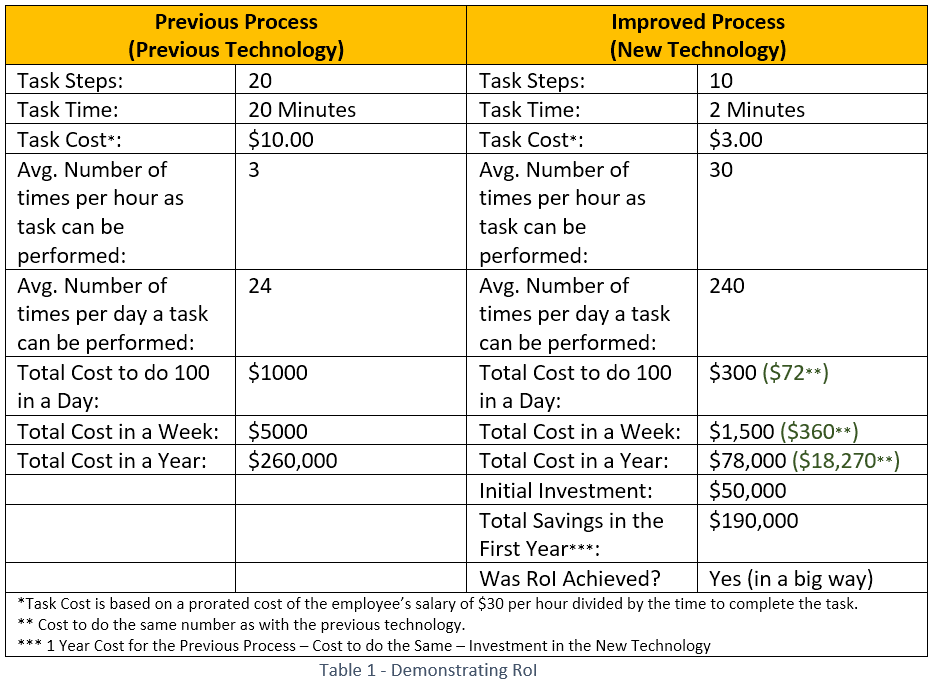
By using the new technology, the task can be completed 10 times faster, is 10 times more productive and can be done at a fraction of what the existing task is costing the organization. No tangible, direct cost savings is realized; however, the intangible, indirect savings through TVM demonstrate significant cost savings and greatly enhanced efficiency to the mission.
Criteria 3 – Stakeholder Buy-In: If all you are going to do is propose to senior leadership that the new technology is the best thing since sliced bread, you have already failed. You must secure stakeholder buy-in from across the spectrum. From the senior leadership that will approve the project that uses the technology to the troops in the trenches who will be putting this technology to use. Like it or not, not only do you have to play the role of subject matter expert for this technology, but you also must play the role of marketing guru. If you can’t sell it, no one is going to buy it.
Criteria 4 – Security: If you want this technology to do the work of the U.S. Government and that means that you are going to have to make sure that it is secure. I am sure most organizations feel this way. The best way to do this in the federal sphere is to ensure that the technology meets Federal Risk and Authorization Management Program (FedRAMP) (FedRAMP, 2020) certification standards before you even think of exploring it as an option. Once you have this done, you will need to ensure that it can pass the Authority to Operate (ATO) process at your organization (and if you don’t have an ATO process; why not?).
Criteria 5 – The Learning Curve: You’ve met all the above criteria and are ready to deploy your new technology for all the masses to reap the benefits. Do they know how to use it? Have you factored in training at all? You better have. If no one knows how to use it and there is no way to learn it, people will push it aside and forget it ever existed.
How easy is this technology to use? How easy is it to learn? The learning curve can make or break the adoption of a technology. Do not expect the IT staff at post to just figure it out on their own and then teach it to the rest of the mission. That is misguided and the quality of the instruction will be horribly uneven. Sure, there are technologies that are easy to pick up. We don’t teach people how to use many of the apps on their phones, but all technologies have some kind of learning curve. The curve may be shallow, it may be steep, but no one is going to simply pick it up through osmosis and when the learning curve is high, there is going to have to be some kind of formal instruction, in person, virtual, or distance learning.
Once you can meet these criteria, you can begin the process of putting forth your project proposal to get stakeholder buy-in. Once you have crossed that hurdle, it will be time to put this new technology to good use.
Works Cited
FedRAMP. (2020). Federal Risk and Authorization Management Program. Retrieved from FedRAMP.gov: https://www.fedramp.gov/