An important aspect of networking and a critical one for bidding is getting your name known. Whenever they can, hiring managers will select people they know or trust people in their network that know you. References are an important resource, sure, but if I can get first-hand recommendations then I will take them over the listed references any day. Getting your name out there is not simply an organic process. It takes work on your part to get the message of you out there. It would be nice if we could all rely on our professional reputation to establish itself for us (which many people seem to do); however, you can help to move this along a lot faster if you embrace establishing a personal brand.
What is a personal brand? First, we must differentiate between a personal brand and the effort of personal branding.
Definition of a Personal Brand: “A personal brand is a widely-recognized and largely-uniform perception or impression of an individual based on their experience, expertise, competencies, actions and/or achievements within a community, industry, or the marketplace at large.”Invalid source specified. This is an external process.
Definition of Personal Branding: “The conscious and intentional effort to create and influence public perception of an individual by positioning them as an authority in their industry, elevating their credibility, and differentiating themselves from the competition, to ultimately advance their career, increase their circle of influence, and have a larger impact.”Invalid source specified. This is an internal process.
The Big Take Away: The personal brand is how people see you. Personal branding is how you communicate and present yourself; showcasing your value. Branding is the what people see. Your brand is the emotional connection between you and your audience. Without it, you’re just another person tooting your horn.
Personal branding is not new. Politicians and entertainers have embraced personal branding for decades. But it is not just for folks in the limelight. If you want people to know who you are, you need to embrace personal branding as well. Using your resume and social media to showcase your personal brand is an excellent way to do this. Simply slapping a photo of yourself and chronicling your experience and education does not tell anyone about who you are. You should define and establish your personal brand before you define yourself on a resume or on social media.
Establish Who You Are
How do you do that? It takes a bit of effort and that effort will pay off in the long run. We do this by leading with a personal branding statement. Your personal branding statement will tell the reader, in a nutshell, who you are on a more personal level.
We then determine three things:
- What are your strengths?
- What are your core values? and
- What are your accomplishments.
Know Your Strengths
- What are you the Go-To Person for?
- What words describe you? (Don’t be afraid to ask others.)
- What kind of solutions am I bringing consistently?
- What are people always asking me about?
- Technical, leadership, career advice, etc.
Know your Core Values
- What needs to be present in your work life/work environment for you to be at your best?
- Where do you draw the line?
Know your Accomplishments
- How do you add value to the organization?
- What are your unique contributions?
- Is there a theme?
Establish What You Can Offer
Once you have figured out who you are, you then must determine what it is that you offer. We are in a very competitive field and in the IT world, we all are expected to do a lot of very specific, technical tasks. What you need to do is to separate yourself from the pack and think about:
- What value do you offer? and
- Think about your successes and use that to emphasize what makes you unique.
Take this and blend it into the information you gathered establishing who you are. This allows us to focus our efforts on your personal brand that make you stand out from the crowd. Once we have that, we must then decide to whom we are going to direct our personal branding statement.
Establish Who is Your Audience
Your personal branding statement needs to be tailored to your audience. As a Foreign Service employee, if I am looking for a posting, I can use acronyms and organizational references that anyone at a prospective post will understand; however, if I try to use that same statement when looking for a job, the person reading it would have no idea of who I am or what I am talking about. A personal branding statement, tailored to my audience, is crucial to success. To determine your audience, ask yourself the following questions:
- Are you building your reputation?
- Are you trying to get a posting during the bid cycle?
- Are you trying to get a job after retirement?
- Are you building your network?
- Who are you aiming your brand at?
- Senior Leadership, your peers, your contacts?
You can then tailor your personal branding statement to your audience in a more meaningful way.
From there you can then expand the conversation to your specific accomplishments, experience, and education for your resume or social media presence.
My Personal Branding Statement
Let’s pull it all together. Taking the information above, I created a worksheet to highlight who I am based on this framework.
My Strengths
- Many in the Foreign Service IT community come to
me for what I call “the other half of being and Information Management
Officer”. We get all the technical
training we could possibly hope for and yet we are also expected to manage,
and, as we move up the ladder, to lead.
Management and leadership in the IT field is very specific and focused. This is where I have made my mark. I am often the first person contacted when it
comes to:
- Mentoring and career path advice;
- Regulations, Policy, and Process issues;
- Navigating the organization;
- Policy
- Procedure
- Organizational Culture
- The Writing of Evaluation Reports;
- The Writing of Project Proposals and White Papers;
- Administrative Portfolios;
- Budgeting
- IT Procurement
- IT Contracts
- Strategic Planning
- Staffing
- FOIA Issues;
- Records Management;
- Increasing Customer Service Satisfaction; and
- How to Foster Innovation.
- When I was special assistant to the Deputy CIO for Operations, one of the other SAs gave me the moniker The O’Verachiever. It stuck. I learned to embrace it and to use it as a fundamental way to identify who I am.
- Positive-Disruptive-Influence is another. Throughout my entire career I have challenged the status quo for the betterment of the organization.
- I am well known. I have built a reputation throughout the Department of State and especially within the bureaus of Information Resources Management and the Regional Bureaus. As a senior advisor in the IRM Bureau once told me, “In fact, ask most anyone in IRM, when you say ‘Chuck said…’ they think of Chuck O’Malley. Now that says something!”
My Core Values
- An environment that fosters innovation, personal, and professional growth is key for me to be at my best; in order to ensure that I can do the same for my staffs. Keeping staff challenged is key. Not by filling their plates with tasks, but by finding opportunities for them to grow as professionals and as people
- I draw the line at those who try to stifle creativity. I can be those to whom I answer or those that answer to me.
My Accomplishments
Unequivocally, I take my greatest pride in the mentoring of my staff and my colleagues. For personal accomplishments, drawing from the strengths-well, I’ll pour off the mentoring and positive disruptive influence examples that showcase who I am at my core:
- In 1997, as the Internet and Intranets were beginning to flourish, my organization saw changes like this with fear and apprehension. A small group of us took the initiative to band together and create an Intranet of our own. Within 2 years every post had an Intranet website. Once the Department embraced it, it became standardized and is now a vital piece in the information chain for U.S. Diplomacy.
- Seeing a vacuum in how we alert mission staff in times of emergency, I developed an app that would alert staff of danger, allow them to check in, and to geo-locate them during the emergency alert. This program received a lot of push-back by my organization in Washington; however, what it did do very effectively was to shine a spotlight on the issue. As older technologies that were becoming obsolete (e.g. landline telephones on copper-wire infrastructures), we needed to fill this gap with 21st Century ways of communicating. This set the stage for the application that the entire State Department uses today. I am proud that I stuck to my principals and ensured the conversation happened to bring the current solution to life.
- As we move up in the IT field, we move from break-fix technicians and server room administrators to managers and then leaders. The issue is that IT employees have myriad technical training available to them, but nothing that covers what we need to know as managers and leaders. Again, I saw a void and I filled it. What started out as a white paper in 2011, became an annual compendium that has grown into a five-volume, 600+ page compendium. My colleagues from around the world soak up its pages like a sponge and scores of them have personally thanked me (electronically and in person) for writing my “IMO Bible”. Many ascribe it directly to why they received their promotions.
My Audience
For my personal branding statement, my example will be aiming at a senior leadership position within the IRM Bureau. Senior leaders set the example for their staffs to follow and I can think of no better way to showcase a lead-by-example theme than through my mentoring and innovation experience. This then distills my statement, tailored to my audience of senior leadership in the IRM Bureau.
The End Product
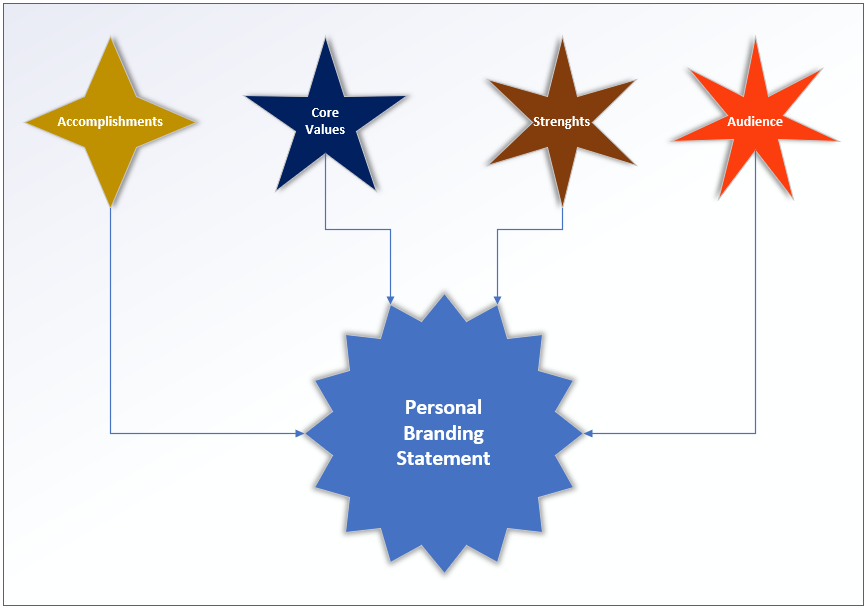
I finally can take everything from my strengths, core values, accomplishments, and audience to craft a meaningful personal branding statement. It all then boils down to this:
I believe that innovation, mentoring, and staff development are critical for the path to success. It all starts with a working environment that fosters innovation, creativity, and life-long learning. I believe that I have been a catalyst in ensuring this working environment thrives wherever I go. I firmly believe in mentoring to advance the next generation of IRM leaders; keeping people challenged and keeping them growing for the benefit the organization and themselves. I have been a positive disruptive influence throughout my career, emphasizing innovation to advance Department goals and objectives through creative projects and by starting and encouraging the difficult conversations that lead to positive change.
This statement takes my strengths, core values, and accomplishments and hammers it down to the core of who I am as a professional, yet it does so at a personal level for the audience at hand.
References
Business2Community.com. (2019, June 11). The 7 Personal Branding Trends That Will Motivate Your Employees. Retrieved from Business2Community.com: https://www.business2community.com/branding/the-7-personal-branding-trends-that-will-motivate-your-employees-02209572
Chan, G. (2018, November 8). 10 Golden Rules of Personal Branding. Retrieved from Forbes.com: https://www.forbes.com/sites/goldiechan/2018/11/08/10-golden-rules-personal-branding/#481a3f7258a7
Lake, l. (2019, November 4). Creating and Growing Your Personal Brand. Retrieved from The Balance Small Business: https://www.thebalancesmb.com/creating-and-growing-personal-brand-2295814
Luberecki, B. (2019, June 12). How defining and honing a personal brand can help you stand out. Retrieved from The Washington Post: https://www.washingtonpost.com/express/2019/06/12/how-defining-honing-personal-brand-can-help-you-stand-out/?utm_term=.1742ebd2c70a
Northeastern University. (2019, January 14). 10 Tips for Building a Personal Brand That Can Boost Your Career. Retrieved from Northeastern University: https://www.northeastern.edu/graduate/blog/tips-for-building-your-personal-brand/
Wikipedia. (2019, June 13). Personal Branding. Retrieved from Wikipedia: https://en.wikipedia.org/wiki/Personal_branding